


The Prime Minister, Pedro Sánchez, has unveiled the National Network of Climate Shelters and has announced €10 million in funding to finance new ones, including educational centres, whilst encouraging local councils, autonomous communities and provincial councils to make “all their public infrastructure” available to these shelters.
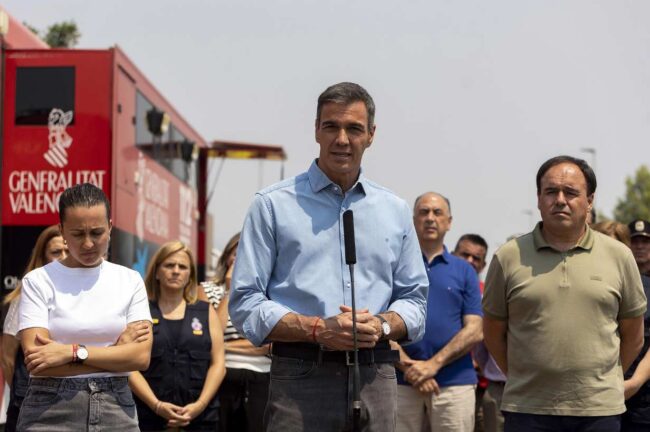
The Prime Minister made these remarks at the close of the presentation of the Climate Shelters Network, as part of the State Pact on the Climate Emergency, which took place at the Ministry for Ecological Transition and the Demographic Challenge, in the presence of the Third Deputy Prime Minister and Minister for the Ecological Transition, Sara Aagesen.
He also announced additional funding of 9 million euros earmarked for the development and consolidation of green infrastructure. “This investment will, amongst other things, enable progress in urban renaturalisation and will strengthen our cities’ preparedness for the ecological transition,” he emphasised.
Accordingly, from this Monday, the Central Government will make a total of 180 shelters available to the public across the country; these will be operational every summer from 15 May to 30 September, as detailed by Aagesen, who also presented a guide containing information on how to set up such a climate shelter and a form to sign up to the national pact, which has been made available on the Ministry’s website.
SCIENTIFIC PANEL ON ACTION TO ADDRESS THE CLIMATE EMERGENCY
Furthermore, the Prime Minister stated that the Government will present the proposal to establish a scientific panel on action against the climate emergency to the Council of Ministers on Tuesday, “an advisory body, comprising some of the very best researchers”, whose task will be to help anticipate risks, evaluate public policies and guide decision-making “with rigour, independence and expertise”.
The Prime Minister has assured that he will not tire “of asking the other political parties and social partners, time and again, to join” the State Pact to tackle the “climate emergency”, because “this really is a national priority”.
“In the face of extreme weather events, a State Pact. In the face of inequalities, a State Pact. And in the face of denial and inaction, a State Pact”, stated Pedro Sánchez, who began his speech by recalling that “at this very moment, many Spaniards are looking anxiously towards the horizon, seeing the flames approaching their villages, leaving their homes without knowing when they will be able to return, and waiting for news of the teams fighting the fires”.
Thus, the Prime Minister’s opening words were for “the evacuated families, for those who remain in lockdown and, of course, also for the professionals who are literally risking their lives” on the ground. “Let them have no doubt whatsoever: the full force of the State – the full force of the State, led also by the General State Administration – stands with them,” he emphasised.
“THE CLIMATE EMERGENCY KILLS”
As the president highlighted, so far in 2026, fires have ravaged around 150,000 hectares in Spain, 13 people have lost their lives and the death toll from heat-related causes in Spain stands at more than 3,800 people. “The figures are clear. Vice-President Sara Aagesen said it earlier. The climate emergency kills,” he stressed.
“What we are experiencing is not a series of isolated incidents. It is the most painful manifestation of a climate emergency that is making sixth-generation wildfires more voracious, heatwaves more intense and our country more vulnerable,” he stated, before adding that summers are “increasingly difficult, destructive and, therefore, deadly”.
Against this backdrop, Sánchez argued that “it is not enough to deal with the consequences”; rather, we must “tackle the root causes”. “We must anticipate the effects and, consequently, better prepare our country to protect people’s lives,” emphasised Sánchez, who believes that Spain is better prepared and that the climate crisis affects the most vulnerable the most.
For them, as the Prime Minister highlighted, “extreme heat and high temperatures are not merely an inconvenience”, but rather “a risk to their health and, therefore, to their well-being”.
“It may be easy to downplay the heat from the privileged position of someone who lives and works in air-conditioned surroundings or who can take refuge in a second home with a private swimming pool, but that is not the reality for millions of families in our country. We are all vulnerable to the heat, but we do not all suffer from it equally”, he warned.
For all these reasons, Sánchez argued that “in the face of an emergency of this magnitude, improvisation is no use”. “Prejudice is no use either – which, unfortunately, we are also seeing in the form of hoaxes spreading across social media – what is needed is evidence”, he emphasised.
EUROPA PRESS