


In Candás, some places are not just points on a map. They are part of the town’s rhythm. The Chapel of San Antonio is one of them. It stands close to the cliffs of the Punta del Cuerno promontory, looking out over the Cantabrian Sea. Reaching it is as much part of the experience as the chapel itself.
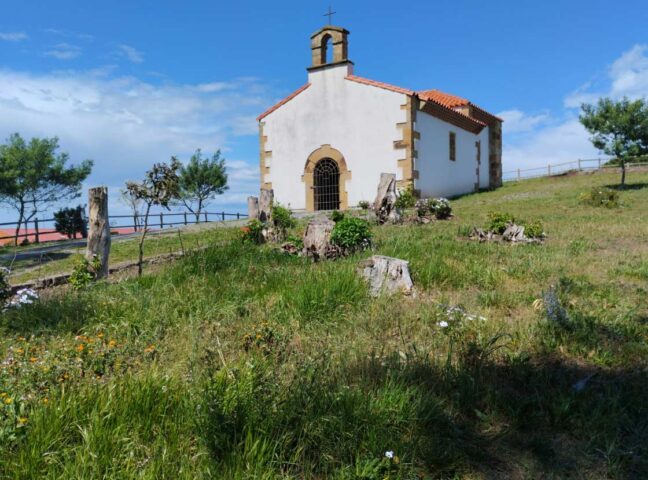
The walk begins near the Antón Museum area. From there, a coastal path leads you through green open spaces and natural surroundings. It is an easy route, suitable for families, and a pleasant choice if you are travelling with children or even pets. In the Gervasia area, there is a free dog zone where dogs can be off-leash under your responsibility, always respecting the environment.
After this first stretch, the path changes character. A gravel track climbs gently between eucalyptus trees. Along the way, small statues appear beside the trail, quietly marking the route. Walking without hurry, the journey takes around fifteen minutes. It is not a demanding climb, just enough to feel that you are leaving the town behind and entering a calmer space.
When the chapel comes into view, it usually surprises first-time visitors. It is a small building, simple but carefully preserved. Today, it is still possible to hold wedding ceremonies there, which tells you something about how alive this place remains in local life.
Around the chapel, wooden fences mark the safe boundary near the cliffs. From this viewpoint, you can see the coastline of Carreño, the Candás lighthouse and the open Cantabrian Sea. It is a spot where people come to walk, to sit under the trees in summer, to exercise, or simply to pause. No artificial viewpoint, no constructed attraction — just a natural balcony over the coast.
This is everyday Candás. Not staged. Not dressed for visitors. Just real.
San Antonio: a date that marks the beginning of summer
Every year, on 13 June, Candás celebrates the festival of San Antonio. Locals often describe it as the “unofficial start of summer”. It is a date marked on the calendar long before the season changes.
The heart of the celebration is the romería held in the prau de Gervasia, the same open area you pass when walking towards the chapel. Hundreds of people gather there. Many wear traditional Candás clothing. Tables fill with food. The smell of bollos preñaos mixes with the sound of bottles of sidra being poured. Asturian music accompanies the day.
One of the key moments is the subasta del ramu, a traditional auction that remains central to the celebration. It is a community ritual more than a performance for outsiders. People attend because they have always done so. Because their parents did. Because it is part of belonging here.
In recent years, the festival has attracted more visitors from outside Asturias. Yet its character has not changed. It is still local, close, genuine. A day when Candás shows its strongest identity: Asturian tradition in its purest form.
Visiting the chapel during these dates adds another layer to the experience. You see not only a building on a cliff, but a place connected to the life of the town, to its calendar, and to its people.
Candás is not a theme park.
It is a lived place.
And the Chapel of San Antonio is one of its quiet witnesses.