


Asturias will bring together around 70 specialists from ten countries in Oviedo for an international conference on space exploration, the space industry and new technologies in the sector.
Asturias becomes a hub for the new space economy
Asturias will strengthen its position in the new space economy by hosting the international conference The Many Pathways to Space, which will take place from 5 to 7 August in Oviedo/Uviéu.
The Regional Ministry of Science, Industry and Employment, together with the Asturias Institute of Space Sciences and Technologies (ICTEA) and the Foundation for the Promotion of Applied Scientific Research and Technology in Asturias (Ficyt), is organising this event, designed to link research, industry and the technological capabilities of different regions with the major challenges of space exploration.
The event will bring together around 70 specialists from ten countries — Spain, Luxembourg, the United States, Italy, the United Kingdom, Japan, Germany, Greece, Turkey and Peru — representing more than thirty universities, research centres, companies, start-ups and space agencies. More than half of the participants will be travelling from outside Asturias, further enhancing the event’s international profile.
Space research, industry and technology
The programme will combine scientific presentations, institutional dialogue and an industrial perspective to address some of the main challenges of the current space race, such as planetary defence, lunar and Martian exploration, space health, habitats in extreme environments, microgravity, orbital debris, and new propulsion technologies and nanosatellites.
Participants will include representatives from organisations such as NASA, the European Space Agency (ESA), the CSIC, the German Aerospace Centre (DLR), the University of Tokyo, the University of Arizona, the University of Central Florida, and the universities of Luxembourg and Edinburgh.
Spanish teams from the Canary Islands Institute of Astrophysics, the Andalusian Institute of Astrophysics and other research centres will also take part, alongside representatives from technology centres, deep-tech start-ups and aerospace companies, with a focus on knowledge transfer to industry.
Asturias contributes its own infrastructure and capabilities
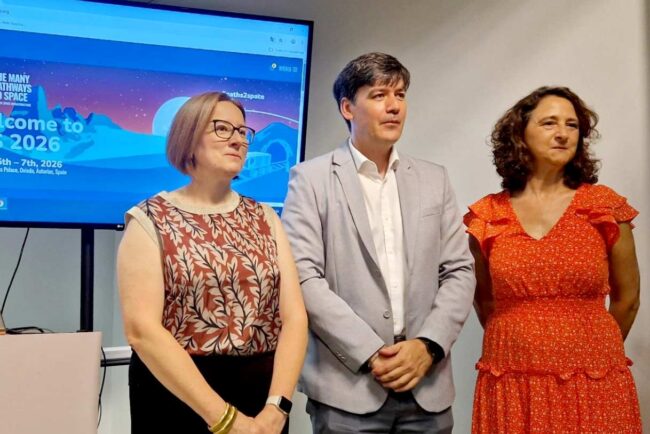
The Regional Minister for Science, Industry and Employment, Borja Sánchez, emphasised during the presentation that Asturias possesses “unique knowledge, industry and infrastructure” to join the new space age.
Accompanied by the conference coordinator, researcher Noemí Pinilla Alonso (ICTEA-University of Oviedo), and the director of Ficyt, Mercedes Díaz, Sánchez highlighted the opportunity to capitalise on Asturias’ innovative ecosystem and the region’s industrial heritage. “The conquest of space is built from Earth,” he stated.
Asturias has already secured an investment of 1.8 million euros through pre-commercial public procurement to develop test beds for nanosatellites and small rocket engines.
Furthermore, mining infrastructure offers new possibilities for space research. The Santiago mine shaft in Aller is ideally suited to simulating lunar lava tubes and testing habitats protected against radiation.
Meanwhile, the Carrio mine shaft in Laviana is hosting research by SERIDA into underground crops under extreme conditions. “If we want to grow food in space, the first trials are already taking place beneath the Asturian soil,” noted Sánchez.
Artemis, planetary defence and the challenges of space exploration
The conference programme includes discussions on the challenges linked to the Artemis mission and sustainable human presence beyond Earth.
Planetary defence will feature prominently, with specialists working on the monitoring and characterisation of asteroids, including Apophis, whose approach to Earth in 2029 presents a scientific opportunity to advance our understanding of these bodies and improve international preparedness for potential natural hazards of space origin.
Key details of the event
- Dates and venue: 5–7 August 2026, in Oviedo/Uviéu.
- Participation: around 70 specialists, with over 60 registered participants and speakers.
- International scope: ten countries and four major geographical regions: Europe, North America, South America and Asia.
- Participating institutions: more than 30 universities, research centres, companies, start-ups and space agencies.
- Participant profile: approximately 50% academic and research staff, 30–35% students and 15–20% from industry, companies and start-ups.